

iTrack, GCQ, and TrackMan Measurements of Golf Ball Spinnery Axis
We all know that spin axis affects the curvature of a golf ball during flight. "Setting up" the shot means hitting the ball with the desired trajectory(curvature); in other words, it's about having the ability to hit the ball with the desired spin axis. Therefore, spin axis control is a key difference between professional and amateur players. Accurate spin axis measurement is crucial.
Here are comparative test data from three instruments: iTrack , GCQ, and TrackMan:
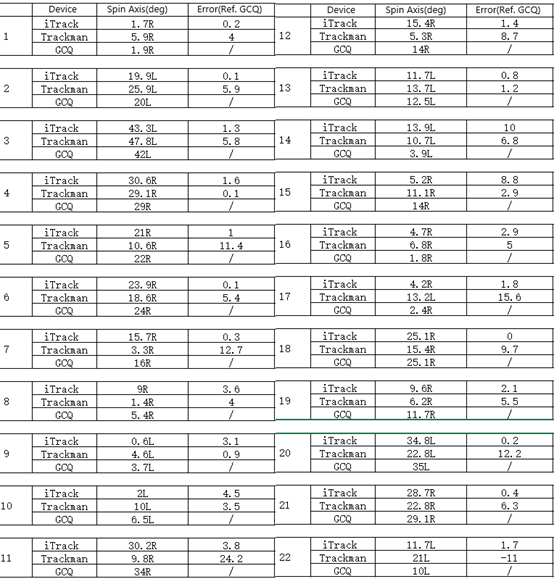
The data shows that iTrack and GCQ data are very close, but their errors compared to TrackMan data are sometimes significant, even showing opposite directions. Why does this happen?
iTrack and GCQ use the same measurement principle: capturing multiple images of the ball during launch using a high-speed camera, and then calculating various data based on these images to obtain launch data such as ball speed, takeoff direction, spin, and spin axis. iTrack and GCQ's calculations are based on the ball's state at the instant of launch.
TrackMan's measurement principle is completely different. It uses radar to track the ball's entire flight trajectory and then infers launch data based on this trajectory: ball speed, launch direction, spin, and spin axis. TrackMan's calculations are based on the ball's entire flight trajectory.
Therefore, iTrack and GCQ's spin axis measurement method is a direct measurement, rather than calculation based on intermediate data, while TrackMan’s spin axis is indirectly calculated through the flight trajectory curve. We know that the spin axis affects the curvature of a ball's trajectory, but this curvature isn't solely determined by the spin axis. Factors such as the ball's center of gravity (COG) not being at the center, surface imbalance, and wind speed all influence the ball's curvature during flight. Furthermore, due to ball imbalance (asymmetry), the different points of impact between the clubface and the ball will cause variations in trajectory curvature because the eccentricity of the ball differs at different impact points. This phenomenon and its underlying principles are readily apparent in putting on the green, and players can address them effectively; we won't elaborate further here. Because TrackMan cannot access information about ball imbalance, wind speed, and impact point, its spin axis readings tend to be inaccurate and are merely estimates.
Professional players can consider factors like wind and ball imbalance and minimize their impact on the trajectory. We recommend that professional players use data from launch monitors like iTrack and GCQ, which utilize high-speed camera principles, for better practice. Because both the ball data and the clubhead/clubface data are "seen" by high-speed cameras, not estimated like radar Launch Monitors. This is proven by the fact that we only see TrackMan busy installing high-speed cameras into their instruments, while we never see Foreisight and others busy installing radar into instruments like GCQ.